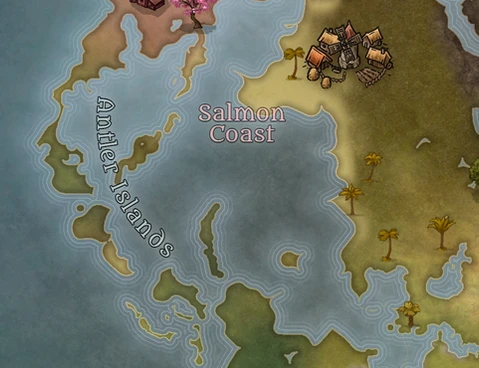
 The Salmon Coast

The Salmon Coast
Across the water from Makino is a lovely and bustling village where cares are far and few between. Compared to its well-developed neighbor, the Salmon Coast is rooted in its natural resources and takes great pride in their cultural niche. Focusing on shipment of goods and self-sustaining livelihoods, its a common getaway spot for stressed outsiders. Faunids who live here are very welcoming to strangers of all shapes and sizes and teeth shape.

The etymology of "Salmon Coast" is quite simple; it's a coast with a rich culture features the fish that dwell there.
History and Mythos
The mythos of the Salmon Coast doesn’t begin with gods. It begins with survival and what comes after.
Elders say that long ago, a group of Makino refugees washed up along this stretch of coast, weathered and worn. Some were fleeing corruption, others had embraced it. Some simply had nowhere else to go. There were no omens and no sacred visions. Only driftwood, wind, and the soft, salmon-colored haze of the distant island on the horizon.
The earliest settlers of the coast believed not in divine intervention but in the patterns of tide and season. To many here, divinity is not a figure with antlers, but a quiet current of connection: between beings, land, and sea.
Oral tradition holds that the first corrupted faunids to settle here did so not to be healed, but to simply be. Free of judgment, free of purpose beyond building what they needed with their own hands. From them came a belief that healing isn’t a goal, but a lifestyle - a constant choice to grow gently, in harmony with one's surroundings, no matter what shape you’ve become.
The Salmon Coast doesn’t chase after old stories. It builds its own, slowly, like barnacles on rock. Belief, here, is less about asking for meaning and more about noticing when it arrives.
Religious Practices
The Salmon Coast faunids often worship Herne through practical gratitude and ecological balance. Their religion is deeply tied to survival, cycles of nature, and mutual aid - especially since they share their community with corrupted individuals who have found sanctuary.
Worship isn't structured, but communal. It's found in rituals like shared meals, harvest festivals, and the careful relocation of their village to avoid harming local ecosystems. To them, Herne is a living presence in the rhythm of the waves, the tides of emotion, and the act of coexistence. He is seen as a god who understands both suffering and second chances; a god who gave life not just once, but continuously, every time they survive another season.
Current Status
Life here follows the rhythm of the tides. With buildings designed to move when needed and a culture rooted in respect for the land and sea, the Salmon Coast is as fluid as it is grounded. The community continues to trade goods like dried fish, handwoven goods, and naturally harvested materials, though the focus remains inward—on sustainability, harmony, and healing.
Though somewhat isolated, the village is far from stagnant. Travelers still arrive, drawn by its warmth and the quiet beauty of its low-impact lifestyle. And despite the island’s mystery, or perhaps because of it, the Salmon Coast thrives as a beacon of coexistence, where corrupts walk freely and all are judged by their character - not their corruption.
Infamy
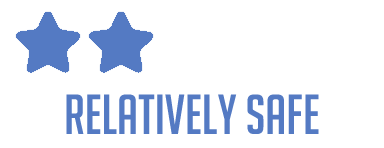
Danger is what you make of it in both Salmon Coat and Antler Islands. It can be just as easily avoided as it is approached.
Architecture
Considered the TRUE ideal sanctuary and vacation area for mainland Faunids, the widespread village is coastal and natural in design. Using only their natural resources in the least intrusive methods possible, the buildings are not made to last forever. rather, they are designed to be constantly built upon and fixed as needed. If needed, their entire village is able to be dismantled and located further along the coastline to ease pressure on the current wildlife.
| ← Locations | The Salmon Coast → |